Imagine you are about to approve a complex DeFi trade on a new DEX: several token approvals, a bridge hop, and a tiny calldata permission that could silently drain a wallet if misused. You want the speed of a browser extension and full multi-chain coverage, but you also need assurance you aren’t “blind signing” an invisible transfer. That concrete moment—clicking Approve—captures why security-first wallets changed from a convenience to a necessity. Rabby Wallet positions itself for that moment with pre-execution simulation and a layered risk scan. For U.S.-based DeFi traders and yield operators who routinely interact across networks and contracts, Rabby’s design choices matter in operational, not just theoretical, ways.
The rest of this essay breaks down how Rabby works, what it actually protects you from, where the protections end, and practical trade-offs when you choose it over mainstream alternatives. I’ll highlight one persistent misconception, offer a simple decision heuristic you can reuse, and close with short signals to watch that will affect whether Rabby’s approach stays ahead or needs to be rethought.
How Rabby reduces “blind signing” and why that matters
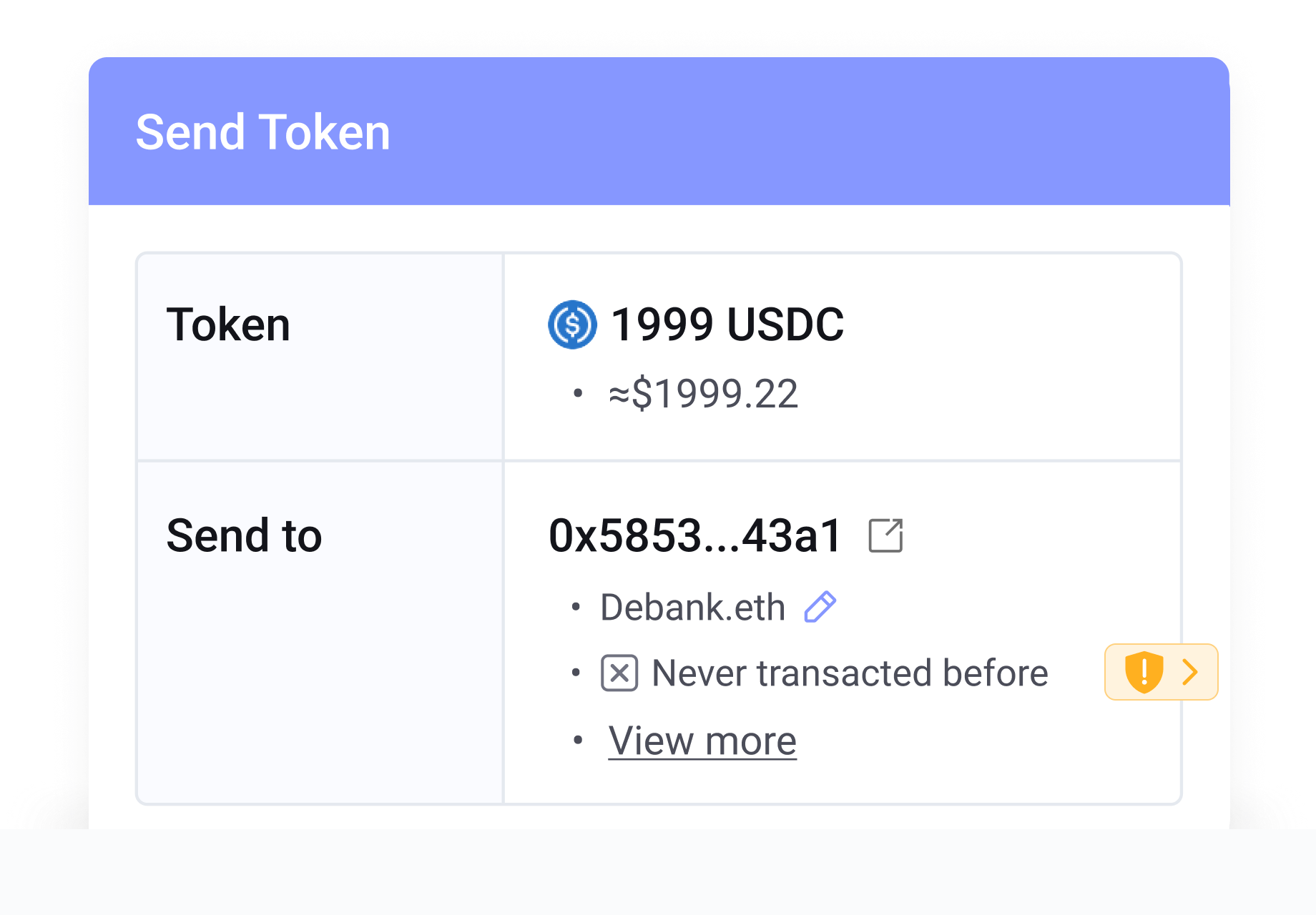
Rabby implements two complementary mechanisms aimed squarely at blind signing: transaction simulation and pre-transaction risk scanning. Transaction simulation runs a dry-run of the intended transaction and displays estimated token balance changes and exact fee costs to the user before signing. That is a mechanistic solution: rather than inferring intent from a contract call, the wallet executes the call in a sandboxed environment and surfaces the result. For a trader, seeing the precise token inflows and outflows lets you spot unintended transfers (for example, a transfer to an unknown recipient) which raw calldata or gas estimates would not reveal.
The pre-transaction risk engine adds another layer by flagging red flags such as interactions with previously exploited contracts, suspicious unlimited approvals, or addresses that don’t resolve to expected counter-parties. Together, simulation plus risk scanning converts a binary “approve/deny” decision into a richer, evidence-based judgment. That reduces a common failure mode where speed and UI fatigue lead to approvals that cost users money.
Practical scope: what Rabby reliably protects you against — and what it doesn’t
Rabby’s protections are strongest for mechanical and known-pattern attacks. If a malicious dApp attempts to transfer tokens during your approval flow, the simulation will show a balance change, and the risk scanner may flag the smart contract if it’s on a list of previously exploited or suspicious contracts. Integration with hardware wallets (Ledger, Trezor, Keystone, CoolWallet, GridPlus, BitBox02) and institutional tools (Gnosis Safe, Fireblocks) raises the bar for adversaries, because signing requires physical confirmation or multi-party agreement.
However, this is also where the common myth needs correction: simulation and scanning are not absolute immunity. They detect behaviors visible to an off-chain simulation and patterns already flagged by security feeds. A contract can be maliciously crafted to behave benignly during a simulated trace but perform harm conditionally on off-chain events or later upgrades—circumstances the simulation may not reproduce. Similarly, zero-day exploits or novel social-engineering flows (e.g., convincing a user to paste a seed phrase) remain outside the scope of pre-execution checks. Rabby reduces, but does not eliminate, operational risk.
Feature trade-offs that matter for power users
Multi-chain breadth is a clear strength: support for 90+ EVM-compatible chains (Ethereum, Arbitrum, Optimism, Polygon, Avalanche, BNB Chain, etc.) plus automatic network switching means fewer failed transactions and less manual network juggling. The wallet’s portfolio aggregation and cross-chain gas top-up are practical for traders operating across L2s and sidechains. Yet this breadth introduces complexity: keeping accurate simulation semantics across many chains and RPC providers is non-trivial. The accuracy of simulation depends on the node used and on the ability to reproduce chain state; in edge cases—forks, mempool-dependent logic, or private oracle outcomes—simulations can diverge from live execution.
Another trade-off concerns usability vs. control. Rabby’s “Flip” feature that toggles between Rabby and MetaMask is a convenience for users who rely on different wallet behaviors, but power users who prefer deterministic signing flows may want to lock down default behaviors. Rabby’s lack of an on-ramp and no built-in staking reduces attack surface and keeps the product specialized, but it also forces users in the U.S. to rely on third-party custodial on-ramps or centralized exchanges for fiat-to-crypto entry—an operational trade-off between feature convenience and systemic risk exposure.
Security pedigree, past incident, and how to interpret it
Rabby is open-source under the MIT license, which invites audits and community scrutiny. That openness, combined with hardware wallet compatibility and approval revocation tools, strengthens the wallet’s practical security posture. Still, transparency is not a guarantee; in 2022 a Rabby Swap smart contract was exploited for roughly $190k. The team froze the contract, compensated users, and expanded audits—responses that show a responsible incident management approach. For decision-makers, the right takeaway is nuanced: a project that responds well to incidents and invests in audits is preferable to one that hides problems, but past remediation does not immunize against future, structurally different attacks.
One reusable decision heuristic for signing flows
Here is a simple, reproducible heuristic to use before you sign: Confirm three axes—(1) Intent: does the simulation show the exact expected token balance changes? (2) Provenance: is the contract counterparty known and not flagged by the risk scanner? (3) Atomicity: is this approval granting unlimited allowances or a narrowly scoped one-time permission? If any axis fails, pause. For approvals you must make, prefer granular allowance over unlimited approvals and, where possible, use a hardware wallet or multi-sig wallet for high-value operations.
That heuristic translates Rabby’s features into a disciplined operational routine rather than a false sense of security.
Near-term signals to watch
Because Rabby’s core differentiator is simulation and scanning, pay attention to: (a) improvements in cross-chain simulation fidelity (how accurately simulations reproduce on-chain oracle-driven behavior), (b) the growth and freshness of security feeds used for risk-scoring, and (c) integrations that reduce friction—such as better hardware wallet UX or tighter multi-sig workflows. Regulatory developments in the U.S. affecting non-custodial wallets—if they require additional KYC or restrict certain integrations—would materially change how wallets like Rabby operate and how institutional partners can integrate them.
FAQ
Does Rabby completely prevent smart-contract hacks?
No. Rabby materially reduces risk by simulating transactions and scanning for known vulnerabilities or suspicious patterns, but it cannot prevent all classes of attack—especially conditionally malicious contracts, off-chain-triggered exploits, or social-engineering that exposes secrets. Use hardware wallets and multi-sig for high-value assets.
How does Rabby compare to MetaMask or Coinbase Wallet for active DeFi traders?
Rabby distinguishes itself through pre-execution transaction simulation and automatic network switching across 90+ EVM chains, which helps avoid blind-signing and wrong-network errors. MetaMask is more ubiquitous; Coinbase Wallet and Trust Wallet integrate stronger exchange on-ramps. Choose Rabby if simulation and approval management are priority features for your workflow; if fiat on-ramp or native staking matter more, pair Rabby with other services.
Can I import my existing wallet into Rabby?
Yes. Rabby supports importing wallets via seed phrase or private key, and offers a Flip toggle to change the browser’s default wallet between Rabby and MetaMask. For safety, import into Rabby only on trusted devices and consider re-seeding into a new hardware wallet for large balances.
For DeFi power users in the U.S., Rabby hits a useful niche: it operationalizes an important defensive idea—see what will happen before you sign—while providing practical multi-chain tooling. But the cleverness of its simulation is only as good as the data and assumptions behind it. Treat Rabby as a strong defensive layer and an operational aid, not a substitute for conservative operational practices: hardware wallets, minimized allowances, and careful counterparty vetting. If you want to explore the wallet details and installation options, see this primer on the rabby wallet.